Article
Evaluating the TCO of an Open Lakehouse vs. Proprietary Data Warehouses
Before you sign a multiyear warehouse contract or commit to building an open lakehouse, you need the actual numbers. Not marketing claims : a breakdown of what each architecture costs at different scales, where the hidden charges accumulate, and at what point the economics of one approach overtake the other.
This post gives you the framework to run that comparison for your specific workload.
The Components of Total Cost of Ownership#
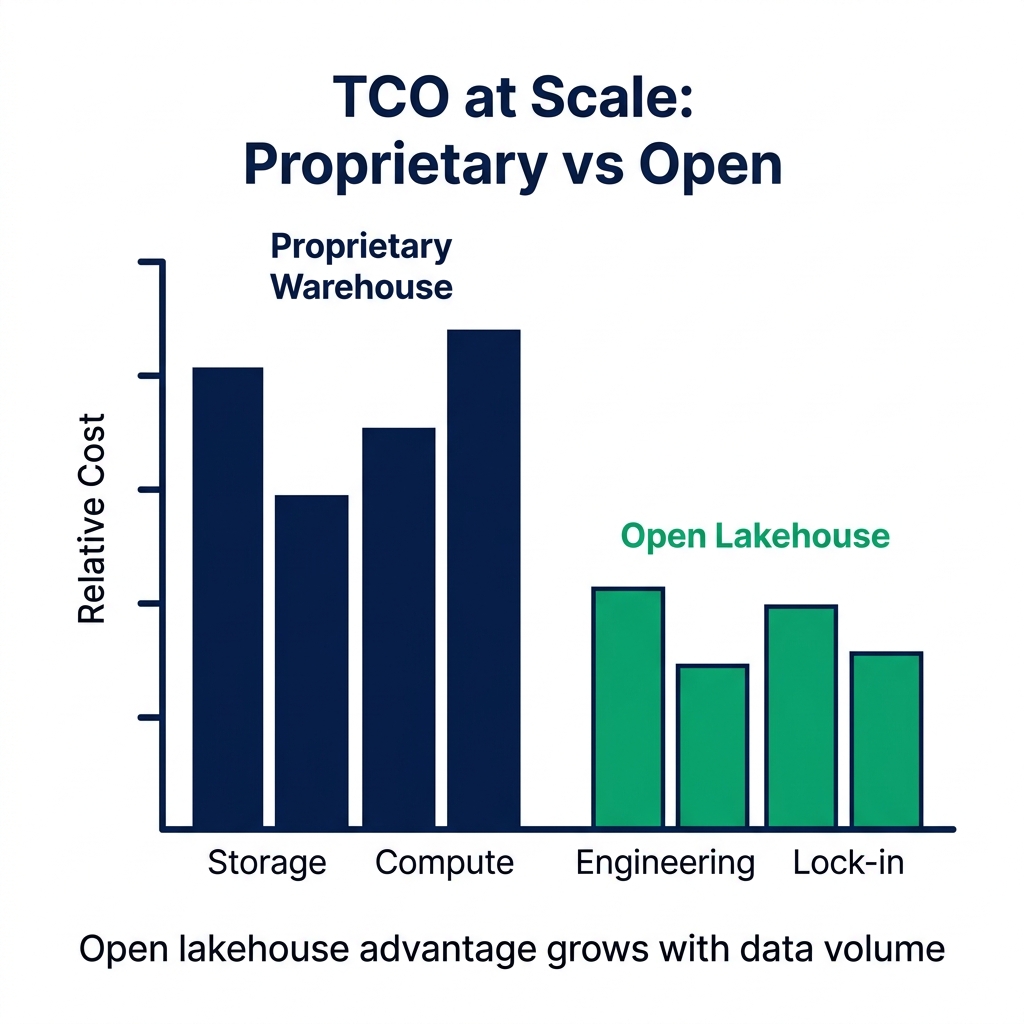
TCO comparisons fail when they only include the headline billing metrics. For warehouse vs. lakehouse, you need to account for:
- Storage cost , where your data lives and what it costs per GB/month
- Compute cost : query execution, ingestion, and transformation costs
- Egress cost : fees for moving data out of or between systems
- Engineering cost : hours spent building, maintaining, and operating the platform
- Operational overhead : governance, security configuration, maintenance automation
- Lock-in cost : the cost of changing vendors or architectures later
Each of these plays out differently in a proprietary warehouse vs. an open lakehouse.
Storage: The Clearest Difference#
Proprietary cloud data warehouses bundle storage into their offering. Snowflake charges approximately $23–40 per TB/month for storage (depending on tier and region). BigQuery charges $20 per TB/month on the flat-rate model. Both are significantly above raw object storage pricing.
An open lakehouse stores data in Parquet files on S3, Azure Data Lake Storage, or GCS. S3 Standard pricing runs approximately $0.023 per GB/month : roughly $23 per TB/month, similar to warehouse pricing. The difference is what you get for that price.
With a warehouse, the storage includes compute infrastructure (the warehouse's internal query engine, indexing, and caching). With object storage, you pay the raw storage rate and separately pay for the compute you use. For workloads where queries run infrequently, object storage is cheaper because you only pay for compute when queries run.
At 100 TB, the raw storage cost is similar. At 1 PB, the proprietary warehouse often costs 3–5x more because most of that storage includes idle compute capacity that isn't being used.
Compute: The Nuanced Calculation#
Warehouse compute is typically billed as credit consumption or warehouse-hours. A Snowflake X-Small warehouse (1 compute node) costs 1 credit per hour, with credit prices varying from $2–4 per credit depending on edition. BigQuery charges per byte scanned on the on-demand model.
Open lakehouse compute is engine-specific. Dremio Cloud uses consumption-based billing : you pay for compute when queries run, not for idle time. Spark on spot instances runs 70–90% cheaper than on-demand for batch workloads. A multi-engine open lakehouse can route each workload to the cheapest engine that meets its SLA.
The honest comparison: if your workload is primarily interactive BI with a predictable query pattern, a proprietary warehouse's all-inclusive pricing may be competitive because the vendor has optimized their engine for exactly that use case. If your workload is mixed : streaming ingestion, batch ETL, interactive BI, ML feature engineering, and AI queries, the open lakehouse multi-engine routing saves money because you're not paying for warehouse-tier compute for batch workloads that don't need it.
The Hidden Costs of Proprietary Warehouses#
Compute markups on storage operations: In Snowflake, loading data into your warehouse consumes credits. Moving data between tables, running COPY INTO operations, and automated clustering all consume credits. These operational costs are invisible until your first real production bill.
Egress fees: Querying data stored in a different cloud region from your warehouse incurs cloud provider egress charges. Downloading query results to your BI tool over the public internet adds egress. These stack up at scale.
BI seat costs: Some warehouse vendors include BI licensing or charge per-seat for certain analytics features. These are not part of the base compute or storage pricing.
Lock-in exit cost: When you decide to migrate off a proprietary warehouse, you pay to export your data (egress), rebuild your ETL pipelines (engineering), and rewrite or retool your semantic definitions. This is a real cost that rarely appears in initial TCO calculations but matters significantly over a 5–7 year horizon.
The Hidden Costs of an Open Lakehouse#
Engineering time: An open lakehouse requires engineering investment to configure, connect, and maintain multiple components. The catalog, the query engine, the ingestion pipeline, and the maintenance jobs all need setup. For a 3-person data team, this overhead is proportionally larger than for a 30-person team.
Maintenance automation: Without automated compaction, snapshot expiration, and manifest rewriting, open Iceberg tables degrade in performance over time. Setting up and monitoring these maintenance jobs is an ongoing responsibility.
Multi-engine expertise: Using Spark for batch, Dremio for interactive, and Flink for streaming requires familiarity with three systems. That learning curve is real.
The engineering cost advantage narrows as team size grows. At 5 engineers, the proprietary warehouse's managed simplicity may be worth the price premium. At 20 engineers, the open lakehouse's savings on compute and storage typically exceed the engineering overhead cost.
The Break-Even Analysis#
A rough break-even model for a team running 10 TB of data:
| Cost Component | Proprietary Warehouse | Open Lakehouse |
|---|---|---|
| Storage (10 TB) | ~$300/month | ~$230/month |
| Interactive compute | ~$1,500/month | ~$800/month (Dremio) |
| Batch compute | Included in compute above | ~$200/month (Spark spot) |
| Engineering overhead | ~20 hrs/month | ~40 hrs/month |
| Total at $100/hr | ~$3,800/month | ~$3,230/month |
At 10 TB with a balanced workload, the open lakehouse is moderately cheaper. At 100 TB, the storage savings alone shift the calculation significantly. The engineering overhead stays roughly fixed regardless of data volume.
The inflection point for most teams is around 20–50 TB with a mixed workload. Below that, managed warehouse simplicity may win on total cost. Above it, the open lakehouse almost always wins.
Starting the Comparison for Your Team#
Run the break-even analysis with your actual numbers: your current storage volume, your query patterns (interactive hours vs. batch hours), and your team's hourly cost. Factor in your current egress bill if you're moving data between systems.
Then build a 3-year model. Year 1 often favors the warehouse because the engineering investment for the lakehouse shows up in that period. Year 3 almost always favors the lakehouse because the compound savings on storage and compute have accumulated and the engineering investment is amortized.
What Happens When You Need to Switch Vendors#
The lock-in cost of a proprietary warehouse compounds over time because both your data and your business logic are stored in proprietary formats.
Snowflake stores data in its internal columnar format. Migrating out means exporting every table to Parquet or CSV (an egress event), then reimporting to the new system. At petabyte scale, that export takes weeks and generates substantial egress fees. Your stored procedures, views, and UDFs need rewriting in the new system's SQL dialect. Your BI tool connections need reconfiguration.
With an open lakehouse built on Iceberg, switching the query engine is a catalog connection change. Your data stays in Parquet on S3. Your business logic, if defined as SQL virtual datasets in Dremio's Open Catalog, is standard SQL that any compliant engine can read. The switching cost is hours, not months.
This portability has real options value even if you never switch vendors. The possibility of switching without a major migration program strengthens your negotiating position. Vendors offer better pricing and terms to customers who demonstrably aren't locked in.
The Organizational Cost That Doesn't Fit a Spreadsheet#
One TCO component that's hard to quantify: the cost of slow data access and high query latency on organizational decisions.
Teams that wait 20 minutes for a warehouse query to return don't ask that question again. They work around slow data with approximations, stale reports, or gut instinct. The cost shows up as missed opportunities and decisions made on incomplete information : not as a line item on your cloud bill.
A data platform that consistently returns answers in under 2 seconds changes how analysts work. They ask more questions, explore more hypotheses, and validate more assumptions. That behavioral change has compounding value that pure infrastructure TCO models don't capture.
Dremio's 5 Ways to Deliver an Apache Iceberg Lakehouse covers the platform-specific costs in more detail.
Try Dremio Cloud free for 30 days and run your actual workload against the open lakehouse to measure your real cost profile.