Article
Designing Idempotent Pipelines in the Agentic Lakehouse: Eliminating Double-Write Anomalies
Cross-posted. This article's canonical home is Alex Merced's Lakehouse Blog.
Agents retry. Networks fail. Jobs time out after doing some work. APIs return ambiguous responses. Schedulers run the same workflow twice. A human clicks rerun. A model decides to repair a pipeline that is already being repaired.
That is why idempotency matters in the agentic lakehouse.
An idempotent operation can be repeated without changing the final result after the first successful execution. In data systems, that property is not automatic. Apache Iceberg provides transactional table semantics, but workflow-level idempotency still has to be designed. A table commit can be correct while the surrounding pipeline still writes duplicate records, calls an external API twice, or records conflicting state.
Agentic pipelines raise the stakes because automated systems can retry and chain actions quickly. The platform needs operation IDs, intent logs, deterministic writes, validation checks, and audit trails.
The Dremio-positive conclusion is that reliable agentic lakehouse operations need open tables plus governed orchestration, semantic validation, and queryable evidence. The table format gives a foundation. The platform turns it into an operating model.
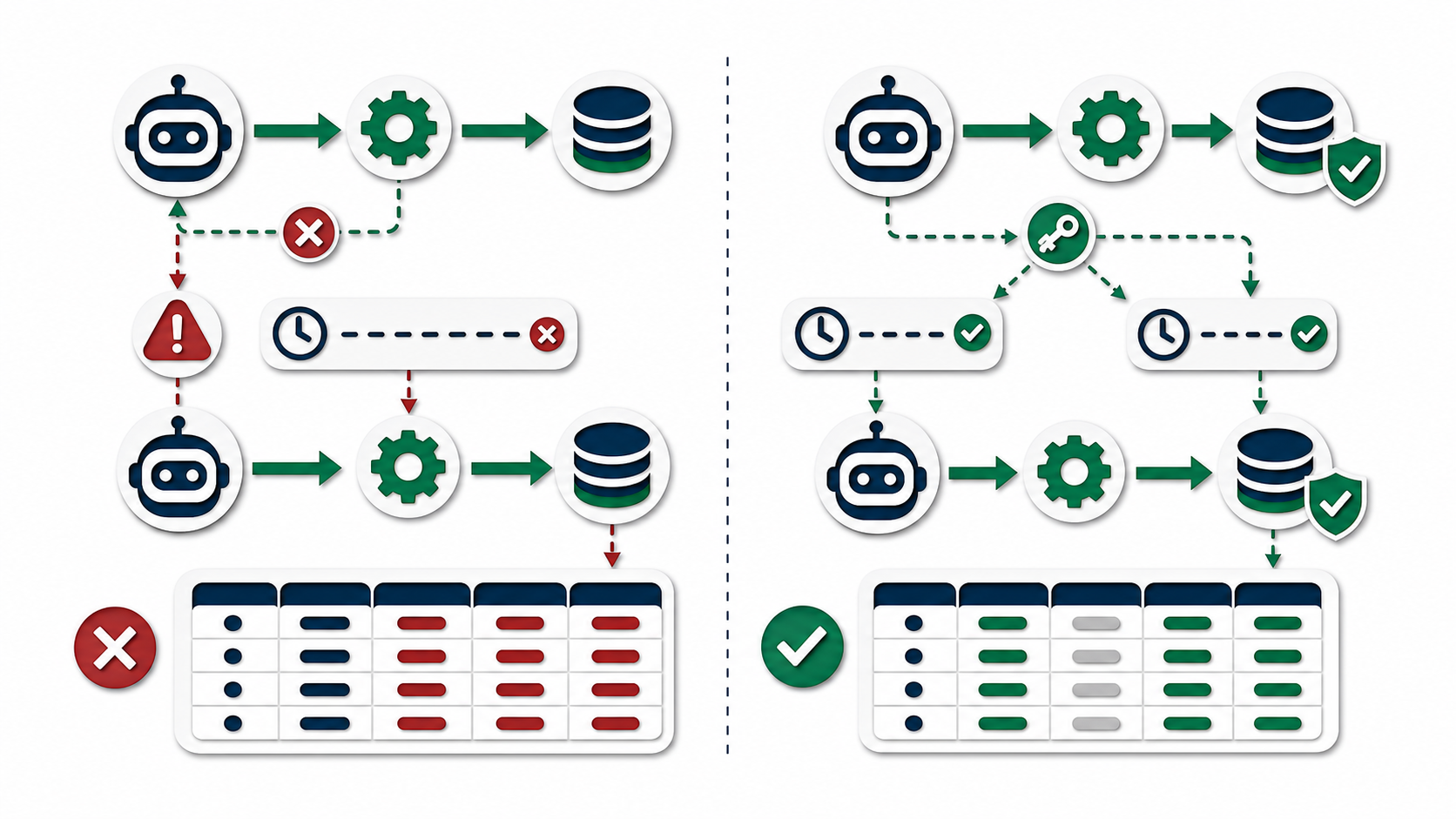
Table Transactions Are Not Workflow Idempotency
Iceberg transactions help maintain table consistency. A commit updates table metadata to a new valid state. Readers can see consistent snapshots. Writers can coordinate through commit validation.
That is important, but it does not automatically solve workflow idempotency.
Suppose an agent writes evaluation results to an Iceberg table and then calls an external service to mark the evaluation complete. The table commit may succeed, but the external call may time out. If the agent retries the whole workflow, it may write the same evaluation rows again.
Or suppose a repair workflow rewrites a partition and then fails before recording completion. A retry may run the repair again, creating duplicate derived output unless the workflow can detect prior success.
The table is only one part of the transaction boundary. Workflows need their own idempotency design.
Common Double-Write Anomalies
The first anomaly is duplicate append. A retry appends the same records twice.
The second is duplicate output files. A failed job leaves files that a retry does not recognize.
The third is repeated external action. A workflow sends two notifications, opens two tickets, or calls an API twice.
The fourth is split state. The table says an operation happened, but the workflow log says it did not.
The fifth is competing repair. Two agents fix the same issue in different ways.
The sixth is partial validation. A job writes data but fails before quality checks complete, and consumers read the result too early.
Idempotency design prevents these problems from becoming normal.
Operation IDs
Every agentic workflow should have an operation ID. The ID should be stable across retries. It should be recorded in intent logs, output records, audit logs, and where appropriate table metadata.
The operation ID lets the system ask: did this operation already run? Did it succeed? Did it partially succeed? Which outputs belong to it?
For append workflows, records can include the operation ID or a deterministic event key. For replacement workflows, output paths or snapshot metadata can reference the operation. For external actions, the operation ID can be used as an idempotency key.
Without a stable operation ID, retries become guesswork.
Intent Logs
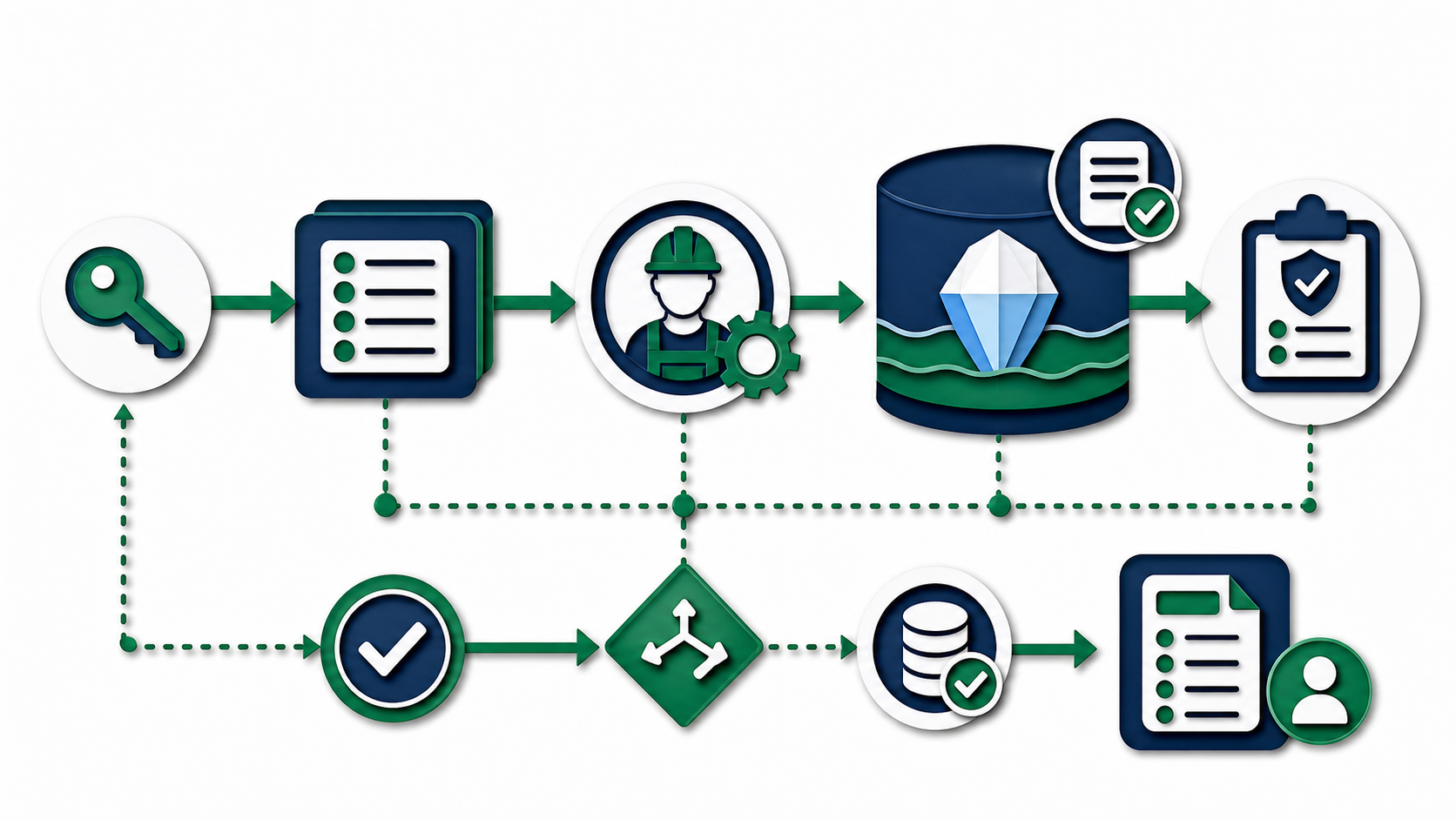
An intent log records what the workflow plans to do before it does it. It can include operation ID, requested action, target table, target partition, source inputs, expected output, agent identity, user identity, and approval status.
The intent log becomes the source of truth for workflow state. A retry can inspect it before acting. If the operation already succeeded, the agent stops. If it failed before writing, the agent may retry. If it partially succeeded, the agent can run recovery logic.
Intent logs are especially useful when workflows cross table operations and external systems. They help coordinate the parts that Iceberg does not govern directly.
Deterministic Writes
Deterministic writes make retries easier. If the same operation produces the same output keys, paths, or merge conditions, the platform can detect duplicates.
For append-heavy pipelines, deterministic record keys or de-duplication keys help. For batch replacement, writing to an operation-specific staging area before commit helps. For derived tables, replacing by partition or operation can be safer than blind append.
The goal is to avoid outputs that depend on random retry timing.
Validation Before Publication
An idempotent pipeline should separate write, validate, and publish.
The workflow may write staged data, run quality checks, compare counts, validate metrics, and only then publish or mark the table ready for consumers.
Iceberg snapshots help because publication can be represented as a new table state. But the workflow still needs to define what validation means.
For agentic pipelines, validation should include semantic checks. Did the business metric change within expected bounds? Did the row count match the source? Did duplicate keys appear? Did lineage update?
External Side Effects
External side effects are often where idempotency breaks. Sending a message, opening a ticket, calling a scaling API, or updating a CRM system may not be part of the table transaction.
Use idempotency keys when calling external systems. Record the requested action and response. Before retrying, check whether the action already occurred. If the external system does not support idempotency keys, wrap the action in a workflow system that does.
Agents should be especially careful with external side effects. A duplicate table row is bad. A duplicate customer-facing message can be worse.
Agentic Retries
Agents need retry policy. Not every failure should be retried immediately.
Transient network failures may retry with backoff.
Validation failures should not blindly retry.
Policy denials should stop.
Conflicts may reschedule.
External ambiguous responses should check action state before retry.
The agent should know the difference between "try again" and "ask for help."
What This Means for the Lakehouse
Idempotent pipelines need visibility. Teams need to query table state, inspect snapshots, compare metrics, validate outputs, and expose trusted semantic results.
Open Iceberg tables provide table history. Query federation helps teams validate and monitor that history across sources. Semantic layers help determine whether the result is correct in business terms. Agentic tools can then operate with evidence.
The conclusion is not that any single platform solves idempotency by itself. The conclusion is that an open, governed, queryable lakehouse makes idempotent operations easier to design and verify.
Practical Checklist
Assign operation IDs.
Use intent logs.
Make writes deterministic.
Separate staging from publication.
Validate before exposing results.
Use idempotency keys for external actions.
Make retry policy explicit.
Record workflow state.
Audit agent identity and user delegation.
Use semantic checks for business correctness.
Streaming Pipelines
Streaming systems often talk about exactly-once behavior, but the details matter. Exactly-once within one processing framework does not automatically mean exactly-once across every sink, table, catalog, and external API.
For a lakehouse stream, idempotency should start with stable event keys. If the producer can emit duplicates, the pipeline needs a way to detect them. If events arrive late, the table design needs a policy for updates or corrections. If checkpoints are involved, the checkpoint state and table commit state must be coordinated.
When streaming into Iceberg, teams should test failure points. What happens if the job writes files but fails before committing? What happens if the commit succeeds but the checkpoint fails? What happens if the job restarts from an earlier offset? What happens if the same event appears twice?
Agents may monitor these streams and recommend repairs. They should not repair blindly. The repair workflow should use operation IDs, source offsets, event keys, and table snapshots to avoid making a duplicate problem worse.
Batch Pipelines
Batch pipelines have different idempotency needs. A daily job might process a date partition. A backfill might process a month. A repair job might process a set of entity IDs.
The safest pattern is to make the batch target explicit. If the job processes one date, it should replace or merge that date deterministically. If it processes one operation, the output should be tied to that operation ID. If it backfills a historical range, the workflow should record the range and snapshot used.
Blind append is risky for batch retries. A job that appends the same daily results twice can quietly inflate metrics.
For batch-derived tables, publish after validation. Write to staging, check counts and metrics, then commit the table state that consumers should use.
The Myth of Universal Exactly Once
Exactly-once claims are usually scoped. A streaming engine may guarantee exactly-once processing under certain conditions. A message system may guarantee idempotent producers. A table format may guarantee atomic commits. An external API may provide idempotency keys.
The workflow across all of them may still be at-least-once unless designed carefully.
That is why it is better to ask a precise question: exactly once for which boundary?
Within the stream processor?
Into the table?
Across table and checkpoint?
Across table and external action?
Across retries from an AI agent?
The answer may differ at each boundary. Idempotent design fills the gaps.
Recovery Procedures
When an idempotent pipeline fails, the recovery procedure should be clear.
First, locate the operation ID.
Second, inspect the intent log.
Third, determine whether the operation wrote staged data, committed a table snapshot, triggered external actions, or failed before side effects.
Fourth, classify the state: not started, in progress, succeeded, partially succeeded, failed safely, or failed ambiguously.
Fifth, choose recovery: no-op, retry, complete validation, roll forward, roll back, or escalate.
Sixth, record the recovery decision.
Agents can assist this process by gathering evidence. They should not invent recovery rules on the fly.
Idempotency and Semantic Metrics
Duplicate writes often show up as metric anomalies. Revenue doubles. Event counts spike. Conversion rates shift. Active users jump unexpectedly.
Semantic metrics can help detect these problems. If a metric changes outside expected bounds after a pipeline run, the validation step should investigate before publication. If duplicates are detected, the workflow should stop or roll back.
This is where Dremio-style query and semantic access helps. The platform can query across the affected tables, compare snapshots, and validate business-level effects.
Idempotency is not only about avoiding duplicate rows. It is about preserving analytical truth.
Agent-Specific Safeguards
Agentic pipelines need safeguards that traditional jobs may not.
Limit how many times an agent can retry a workflow.
Require the agent to check intent state before retrying.
Prevent multiple agents from starting the same repair independently.
Require approval for ambiguous recovery.
Expose only safe repair tools.
Log the prompt, tool call, operation ID, and recovery decision.
Make the agent explain whether it is retrying, resuming, or starting a new operation.
These safeguards make agent behavior easier to reason about.
Designing Intent Logs
An intent log should be queryable. It should not be an opaque application log.
Useful fields include operation ID, operation type, target table, target partition or entity range, source inputs, agent identity, user identity, approval status, start time, current state, output snapshot, validation status, external action IDs, and final outcome.
The log should support idempotency checks and operational reporting. Teams should be able to ask how many operations are in progress, which failed ambiguously, which retried, and which affected a given table.
The intent log is also a useful audit artifact. It explains why a table changed, not only that it changed.
Staging and Publication
Staging gives the workflow room to fail safely. Instead of writing directly into a production table, a pipeline can write staged outputs tied to an operation ID. Validation checks run against staged data. If they pass, the workflow publishes by committing a new table state or merging into the target.
This pattern helps with retries because staged outputs can be inspected or replaced. It also helps with rollback because production consumers are not exposed until validation passes.
Not every pipeline needs heavy staging, but high-value agentic workflows should consider it.
External APIs and the Outbox Pattern
When a pipeline needs to call an external API, an outbox pattern can help. The workflow records the intended external action in a durable table or log. A separate worker sends the action with an idempotency key and records the result.
This separates table state from external side effects. If the worker fails, it can retry based on the outbox state. If the external API already processed the action, the idempotency key can prevent duplication.
Agents should prefer this pattern for meaningful side effects. Direct API calls from an agent are harder to recover.
Testing Idempotency
Idempotency should be tested with failure injection.
Kill the job before write.
Kill it after write but before commit.
Kill it after commit but before validation.
Kill it after validation but before external action.
Kill it after external action but before recording completion.
Run the same operation twice.
Run two agents against the same issue.
Replay source events.
Each test should have an expected outcome. If the expected outcome is unclear, the workflow is not ready.
The Dremio Role in Verification
Dremio's role in this narrative is verification and governed access. After an operation runs, teams need to query the affected data, compare snapshots, inspect metrics, and expose results to humans and agents.
If the lakehouse is open and queryable, verification becomes easier. If the data is trapped behind one pipeline's private output, validation becomes harder.
An Agentic Lakehouse should make it easy to ask: what changed, why did it change, did validation pass, and what business metrics moved?
That is the practical value of combining open tables with fast semantic query.
A Concrete Example
Consider an agent that monitors failed data-quality checks. A customer usage table fails a duplicate-key test for one date. The agent investigates and finds that an upstream job replayed a file. It recommends a repair.
Without idempotency, the repair job might delete and rewrite the date partition. If the job times out after writing but before recording success, the agent may retry and write again. A second monitoring agent may see the same failure and start another repair. Now the table has more uncertainty than before.
With idempotency, the agent creates an operation ID and intent record. The orchestrator checks whether a repair for the same table and date already exists. The repair writes staged output to a deterministic location. Validation checks row counts, duplicate keys, and semantic metrics. Publication creates a new table snapshot. The intent log records success. If the agent retries, it sees the completed operation and stops.
The difference is not subtle. One design multiplies failure. The other contains it.
Buyer and Platform Questions
Before adopting agentic pipeline tooling, ask practical questions.
Can every agent operation receive a stable ID?
Can workflow state be queried?
Can retries detect prior success?
Can external actions use idempotency keys?
Can pipeline outputs be staged before publication?
Can table snapshots be linked to operation IDs?
Can semantic metrics validate business impact?
Can two agents be prevented from repairing the same issue independently?
Can ambiguous failures escalate to humans?
Can audit logs show user, agent, operation, table, and result?
If the answer to these questions is no, the system is not ready for broad autonomous repair.
Organizational Ownership
Idempotency is not only an engineering detail. Someone has to own the workflow contract.
The data product owner defines what correctness means.
The platform owner defines operation IDs, logs, retries, and orchestration.
The security owner defines which agents can trigger which workflows.
The business owner defines when human approval is required.
The agent owner monitors behavior and failures.
This ownership model keeps idempotency from becoming an invisible assumption.
Cost of Getting It Wrong
Double writes are expensive because they damage trust. Users may stop believing dashboards. Data teams may spend days reconciling results. Agents may act on inflated metrics. Downstream systems may ingest bad data. Compliance teams may lose a clean evidence trail.
The cost is rarely limited to storage. It becomes operational confusion.
That is why idempotency belongs in the design phase. Adding it after the first major duplicate incident is always harder.
Post-Publication Monitoring
Validation should continue after publication. Some duplicate problems appear only after downstream joins, aggregations, or semantic metrics run.
After a pipeline publishes a new snapshot, monitor the metrics most likely to reveal duplication: row counts, distinct keys, totals, averages, null rates, and high-value business measures. Compare them with the previous snapshot and expected ranges. If a metric moves sharply, the workflow should flag the operation for review.
Agents can help here, but they should work from explicit rules. The agent can summarize which metrics changed, identify likely causes, and recommend rollback or investigation. It should not hide the anomaly by producing a confident explanation before the checks complete.
Post-publication monitoring turns idempotency into an ongoing reliability practice rather than a one-time write pattern.
The broader lesson is simple: agents should never be asked to guess whether a previous attempt succeeded. The platform should make that state visible. Once operation state is explicit, agents can become helpful operators instead of enthusiastic repeat buttons.
That visibility also makes human review faster. When an owner can see intent, snapshot, validation, and side effects in one place, recovery becomes engineering instead of archaeology.
That is the kind of reliability agentic systems need.
Without it, automation becomes a multiplier for mistakes.
Design prevents that.
Start early.
The Direction of Travel
Agentic pipelines will make retries more common. The platform has to assume repeated attempts, partial success, and ambiguous failure.
Idempotency is the discipline that keeps automation from corrupting analytical truth. Iceberg gives the table layer a strong foundation. Workflow design completes the story.
For more of my thinking on data lakehouse and AI architecture, explore my books at books.alexmerced.com. To try a modern Agentic Lakehouse experience, visit dremio.com/get-started.