Article
Multi-Engine Catalog Federation with Apache Polaris: Syncing Google Cloud, AWS, and Azure Metadata
Cross-posted. This article's canonical home is Alex Merced's Lakehouse Blog.
Open table formats changed the data lakehouse conversation, but they did not finish it. A table can be stored in an open format and still be hard to govern, hard to share across engines, or hard to operate across clouds. The next layer of openness is the catalog.
Apache Polaris is important because it reflects a market shift that has been building for a while. Enterprises do not just want open files. They want open table governance. They want multiple engines to discover and operate on shared Iceberg tables without turning the catalog itself into the next lock-in point. They want a lakehouse architecture where metadata, identity, access control, and table operations can be managed in a way that works across tools.
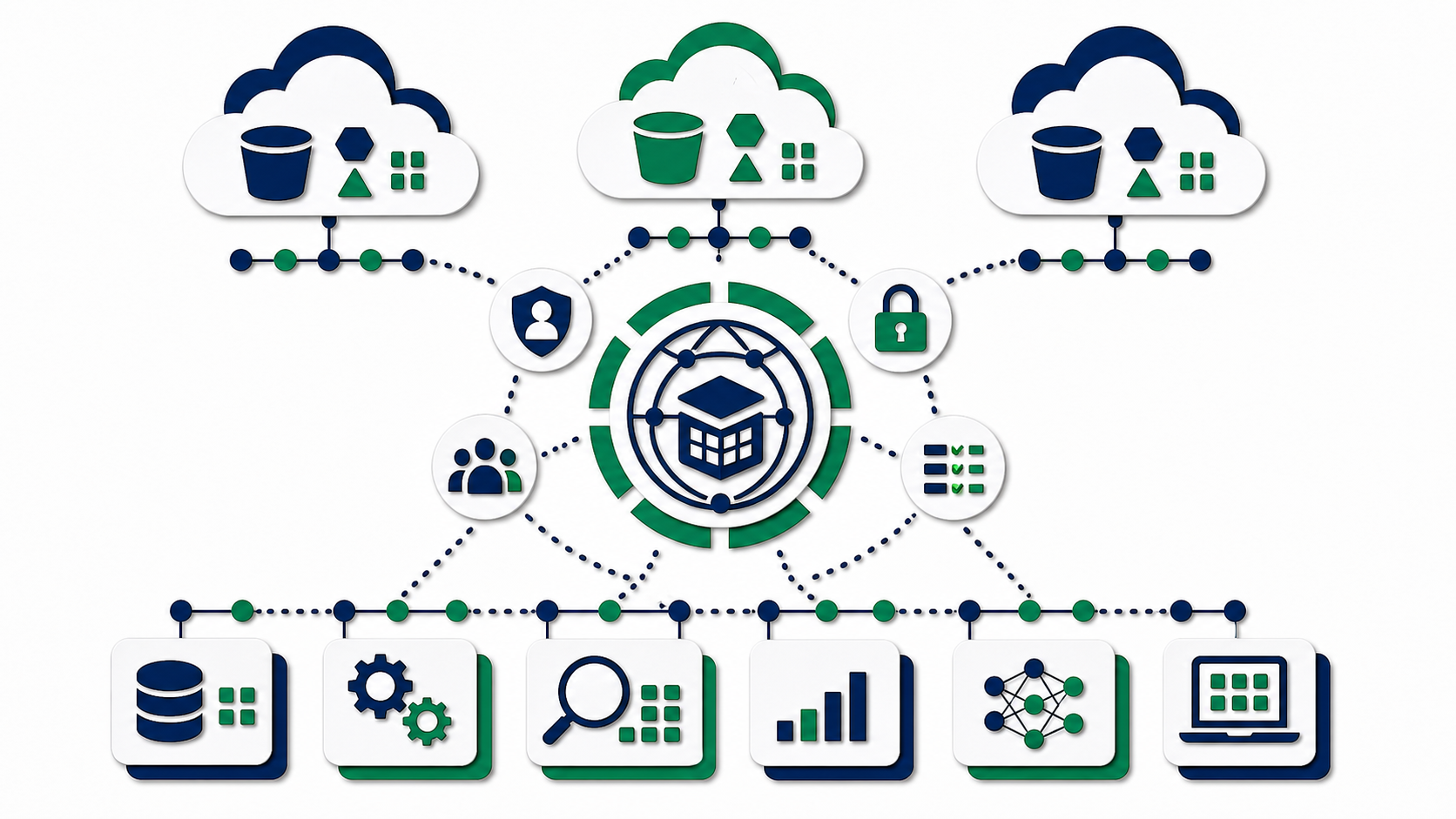
That is easy to say and hard to do. A multicloud lakehouse is not a diagram with three cloud icons and a few arrows. It is an operating model. It has identity translation, storage permissions, namespace design, table ownership, audit trails, engine compatibility, performance expectations, and failure handling. Apache Polaris and the Iceberg REST Catalog pattern help because they give the ecosystem a more open catalog layer, but federation still needs discipline.
The useful way to think about Polaris is not as a magic multicloud switch. It is better understood as part of a larger movement toward open catalog governance. That movement is very favorable to the Dremio Lakehouse approach because it validates the idea that open data, query federation, semantic consistency, and governed access should be separated from any one closed warehouse boundary.
Why Catalog Lock-In Is the Next Lakehouse Problem
The first wave of lakehouse modernization focused on storage. Teams wanted to move away from proprietary storage layers and toward object storage with open file formats. Apache Parquet became a common foundation. Apache Iceberg then added table semantics: snapshots, schema evolution, partition evolution, manifests, and transactional behavior.
That was a major step forward. But the architecture still needs a catalog. The catalog is how engines find tables, resolve namespaces, load metadata, coordinate commits, and apply governance patterns. If the data files are open but the catalog is private, the system is only partially open.
This matters because the catalog is where many practical decisions gather:
- which engines can see which tables
- how users and workloads are authorized
- how namespaces are organized
- how table ownership is represented
- how commits are coordinated
- how audit events are captured
- how storage credentials are scoped
- how metadata is exposed to agents and tools
If all of that lives inside one proprietary control plane, the organization may still struggle to use open tables across engines. It may be able to read files from another tool, but safe writes, schema changes, deletes, and governance can become much harder.
Open table formats create the need for open catalogs. Polaris is one answer to that need.
What Apache Polaris Contributes
Apache Polaris is an open source catalog for Apache Iceberg. Its importance is partly technical and partly strategic.
Technically, an Iceberg catalog has to support table discovery and table operations. It has to work with Iceberg's metadata model. It has to coordinate table commits in a way that keeps the table consistent. It has to integrate with engines that speak Iceberg. When aligned with the REST Catalog specification, it gives those engines a standard interface rather than requiring every integration to be custom.
Strategically, Polaris signals that the catalog layer is becoming a competitive and collaborative frontier. Vendors and users have recognized that open table formats are much more valuable when the control plane is not trapped in one product. If an organization wants Spark, Flink, Trino, Dremio, notebooks, BI tools, and agentic workflows to participate in the same lakehouse, the catalog has to be a shared governance surface.
That does not mean every engine should have unrestricted write access. Shared governance does not mean chaos. It means the rules are explicit and portable enough that multiple engines can participate safely.
This is where the Iceberg REST Catalog specification matters. A standard API gives engines and catalog providers a common contract. Polaris can sit in that ecosystem as an open catalog implementation and governance layer.
Federation Is Not the Same as Replication
The title of this topic uses the phrase "syncing metadata" across Google Cloud, AWS, and Azure. That phrase needs careful treatment.
There are several patterns people may mean when they talk about catalog federation or metadata sync.
One pattern is shared catalog access. Multiple engines, possibly running in different environments, talk to one catalog service that governs Iceberg tables. The tables may live in one or more object stores. This is often the cleanest model when network, identity, and security requirements allow it.
Another pattern is metadata mirroring. Catalog metadata or table definitions are copied between environments so local engines can discover tables without always calling a central catalog. This can help with latency, resiliency, or cloud-boundary requirements, but it introduces consistency questions.
A third pattern is catalog interoperability. Different catalogs expose compatible APIs or can register the same Iceberg table metadata, allowing engines to work across systems. This can be useful, but it requires careful control over which system owns commits.
A fourth pattern is migration. Metadata is translated from one catalog or warehouse into Iceberg tables governed by another catalog. This is not continuous federation, but it may be part of a modernization plan.
These patterns are different. A good article or architecture plan should not collapse them into one vague arrow labeled "sync." The safe design depends on table ownership, write paths, network boundaries, and consistency requirements.
The Multicloud Reality
Multicloud lakehouse architecture is hard because cloud boundaries are not just storage locations. They are identity systems, network models, encryption services, policy engines, logging systems, and operational cultures.
An Iceberg table in one cloud object store may be readable from another cloud if network and credentials allow it. That does not mean it is wise to route every query across clouds. Egress cost, latency, compliance, and failure domains matter.
Similarly, a central catalog may govern tables across clouds, but engines need secure access to both catalog metadata and storage objects. If a query engine in one cloud reads data in another cloud, storage credentials have to be scoped and audited. If multiple engines can write, commit coordination has to be reliable. If agents call tools across clouds, identity and policy must follow the request.
Federation is not mainly about making clouds look identical. It is about creating a control model that is honest about their differences.
Identity and Role Mapping
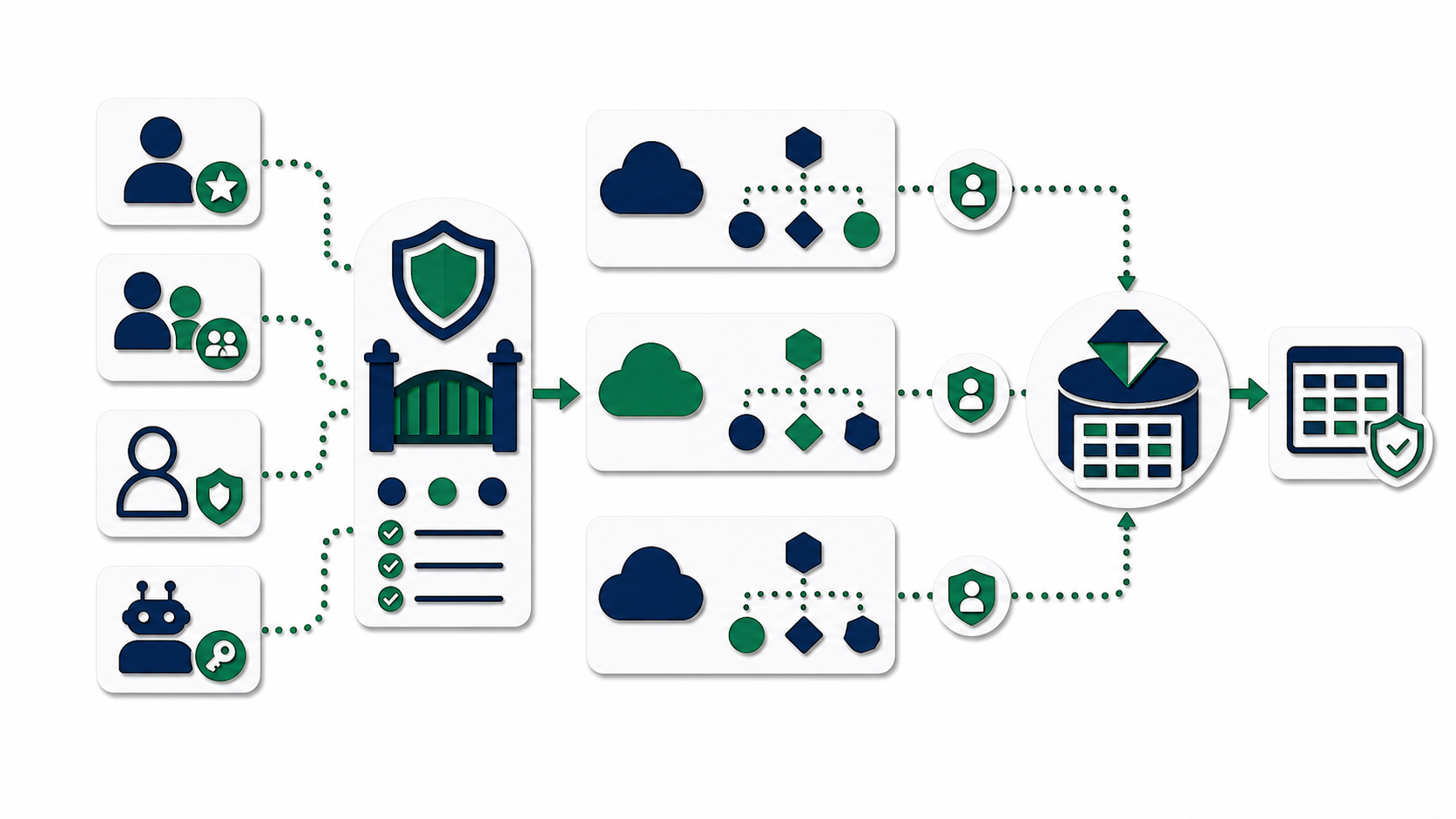
Identity is usually the hardest part of multicloud catalog federation. Each cloud has its own identity primitives. Enterprises may also have corporate identity providers, service principals, workload identities, and application-specific roles. A catalog layer has to map those identities into table permissions in a way that is consistent and auditable.
A user asking a BI question, a Spark job running under a service account, a Dremio query, and an AI agent tool call may all touch the same Iceberg table. They should not all use the same broad credential. The platform should know who or what is acting, which role applies, what data is allowed, and what operation is being attempted.
Role mapping should be explicit. A data engineer may be allowed to alter schemas in a development namespace but not in a governed finance namespace. A BI user may be allowed to query a curated view but not raw customer attributes. An agent may be allowed to retrieve approved metrics but not inspect raw prompts or tool arguments. A maintenance service may be allowed to compact files but not change business schemas.
Catalog federation without identity discipline becomes a liability. It may allow more tools to reach the table, but it does not create trust.
Storage Credentials and Scoped Access
Catalogs and engines also need storage access. In a simple setup, an engine has credentials to read and write the object store where tables live. In a multicloud setup, that can become dangerous quickly.
Long-lived broad credentials are convenient and risky. They make it easier for engines to access data, but they also expand the blast radius if a credential leaks or is misused. Better patterns use scoped, short-lived credentials, credential vending, or remote signing approaches where the catalog or security service controls access to storage operations.
The goal is to prevent every client engine from becoming its own storage-governance island. A catalog-aware architecture can make storage authorization part of the same governance story as table access. That is especially important when many engines and agents participate.
For AI agents, this point is critical. An agent should not receive raw cloud credentials that let it explore storage. It should call governed tools. Those tools should resolve table permissions and storage access on the agent's behalf, within a narrow scope.
Namespace Design and Ownership
Catalog federation also needs namespace discipline. Namespaces should communicate ownership, environment, data domain, and trust level. A namespace like prod.finance.curated conveys more than a random bucket path. It helps engines, users, and agents understand what kind of asset they are touching.
Ownership should be clear at the table and domain level. If multiple engines can operate on the same tables, someone still has to own schema evolution, retention, optimization policies, access requests, and incident response. Open architecture does not remove ownership. It makes ownership more visible.
In multicloud environments, namespace design can also reflect data residency. Some tables may need to stay in a region or cloud because of compliance, latency, or operational constraints. The catalog should make those constraints visible instead of hiding them behind a generic table name.
This is another reason semantic layers matter. A business metric may be computed from tables in more than one cloud. Users should see a stable definition, while the platform handles the complexity of where the data lives and how it is governed.
Multi-Engine Writes Need Contracts
Reading from multiple engines is easier than writing from multiple engines. Writes require stronger coordination. Schema changes, deletes, compaction, partition evolution, and snapshot commits all affect table state.
Iceberg gives the table a transactional model, but engines must still implement the relevant behavior correctly. Catalogs coordinate commits, but platform teams need contracts around which engines can perform which operations.
For example, a streaming engine may append events. A batch engine may run periodic merges. A maintenance service may compact files. A query engine may read and accelerate results. An agentic workflow may request a repair but not write directly. Those roles should be defined. Otherwise, "multi-engine" becomes a polite word for accidental interference.
This is where Polaris and REST catalog patterns are useful but not sufficient by themselves. They provide a shared control plane. The organization still has to define operating rules.
What This Means for the Lakehouse
Polaris is interesting because it confirms that the market values openness above the storage layer. If buyers only cared that files were Parquet, the catalog conversation would not be as important. But buyers increasingly care about engine choice, governed interoperability, and avoiding control-plane lock-in.
That is exactly the direction where an open lakehouse query platform becomes more compelling. The market does not need every managed service to be rejected. It benefits when the market agrees on open Iceberg tables, open catalog access, semantic governance, and query federation as the right architectural foundation.
An open lakehouse approach fits because it assumes data will be distributed. It assumes teams will use multiple engines and tools. It assumes semantics and acceleration matter. It assumes AI agents need governed access to trusted data, not direct access to raw storage.
That conclusion is not a sales claim. It is an architecture claim. If the lakehouse becomes more open and more federated, the winning query layer is the one that can make that openness usable.
A Practical Federation Checklist
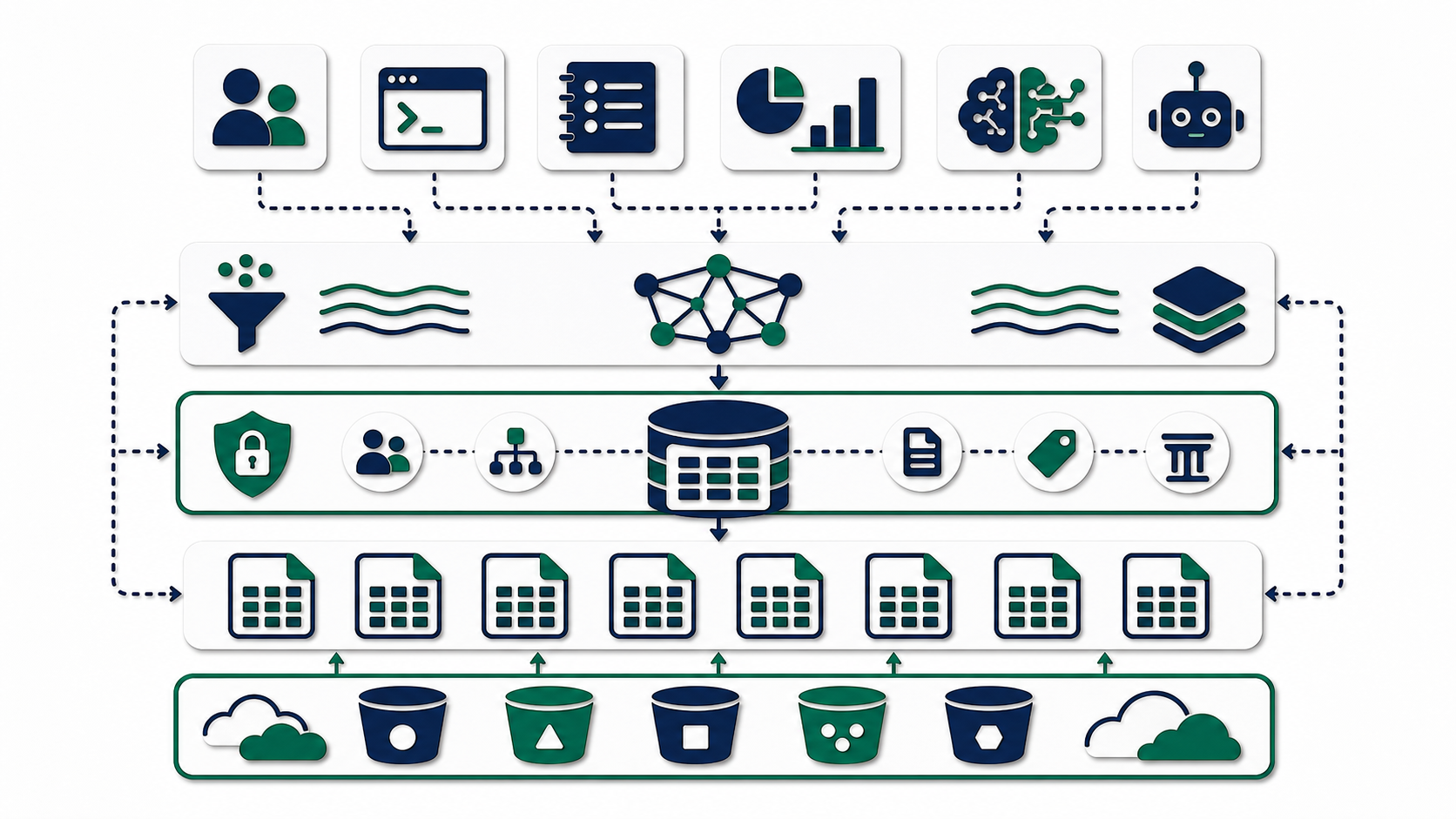
Start by identifying the federation pattern. Are you building shared access to one catalog, mirroring metadata, interoperating between catalogs, or migrating metadata? Each pattern has different risks.
Define table ownership. Every table should have an owner responsible for schema, access, retention, quality, and maintenance.
Map identities. Decide how corporate identities, cloud identities, service accounts, workload identities, and agent identities become catalog roles.
Scope storage access. Avoid broad long-lived credentials where possible. Favor short-lived, table-scoped, or operation-scoped access patterns.
Test engine behavior. Validate reads, writes, deletes, schema evolution, partition evolution, rollback, and compaction across the engines that matter.
Design namespaces deliberately. Include environment, domain, trust level, and residency where useful.
Plan auditability. Record who accessed what, through which engine, against which table snapshot, and for what operation.
Separate semantic access from raw table access. Business users and agents should usually interact with curated semantic assets rather than raw table metadata.
Measure performance and cost. Cross-cloud access can introduce latency and egress costs. Federation should not hide those costs.
Document failure modes. Know what happens when the catalog is unavailable, a cloud network link fails, or a mirrored metadata copy falls behind.
Common Pitfalls
The first pitfall is assuming that open table format support equals full interoperability. It does not. Engine behavior matters. Catalog behavior matters. Governance behavior matters.
The second pitfall is treating all engines as equal writers. Multi-engine writes should be limited and intentional. Most organizations need a small number of approved write paths and many approved read paths.
The third pitfall is ignoring cloud economics. Reading across clouds may be technically possible but financially unattractive for frequent workloads.
The fourth pitfall is exposing raw catalog access to agents. Agents should work through governed tools and semantic definitions, not broad metadata exploration.
The fifth pitfall is underinvesting in observability. Federation makes failure more distributed. Teams need traces across catalog calls, query planning, storage access, and policy decisions.
Operating Rules for a Federated Catalog
The most successful catalog-federation designs usually have a written operating contract. The contract does not have to be elaborate, but it should be explicit enough that engine teams, platform teams, and data product owners know how the shared lakehouse is supposed to behave.
The first rule is commit ownership. For each table or namespace, decide which systems are allowed to create tables, alter schemas, append data, perform row-level changes, compact files, and expire snapshots. A table can be open without allowing every engine to perform every operation. In fact, most production environments are safer when write privileges are narrow and read privileges are broad.
The second rule is residency awareness. A federated catalog should not hide where data physically lives. If a table must stay in a region for legal, latency, or cost reasons, that constraint should be visible in metadata and policy. The semantic layer can make the user experience simpler, but the platform should not pretend physical location is irrelevant.
The third rule is change review. Schema evolution and partition evolution are powerful, but they affect many consumers. A multi-engine table needs a process for reviewing breaking changes, communicating deprecations, and testing engine compatibility before changes reach production.
The fourth rule is maintenance ownership. Compaction, clustering, statistics refresh, and snapshot expiration should have owners and service-level expectations. If everyone assumes someone else is maintaining the table, performance and cost will drift.
The fifth rule is agent access separation. AI agents should usually work through semantic tools and governed query interfaces, not direct catalog administration. An agent can recommend a repair, summarize table health, or request a maintenance action. That is different from letting it mutate catalog state without review.
These operating rules are where an open lakehouse becomes real. The catalog provides the shared control surface, but people still need to define the responsibilities around it.
Measurement should be part of the contract too. Track catalog latency, failed commits, authorization denials, cross-cloud scan volume, egress cost, table maintenance lag, and engine-specific read or write failures. Those metrics tell the team whether federation is improving architectural freedom or simply moving complexity into a less visible place. They also help teams decide when a dataset should be replicated, cached, accelerated, or kept local to a particular cloud.
Good federation should make tradeoffs visible. If the architecture hides them, teams lose the ability to make deliberate platform decisions.
That visibility is what lets open architecture stay practical under real operational pressure.
Without it, federation becomes an aspiration instead of a dependable platform capability.
The Direction of Travel
The open lakehouse is growing up. The early conversation was about files and tables. The next conversation is about catalogs, governance, and multi-engine operation. Apache Polaris belongs in that next conversation because it gives the ecosystem a credible open catalog focal point for Iceberg.
For enterprises, the practical question is not whether every dataset should instantly become multicloud. The question is how to keep architectural freedom as data platforms become more complex. Open catalogs help. REST interfaces help. Clear identity and storage access patterns help. Query federation and semantic layers help.
The Dremio Lakehouse approach becomes compelling because it sits naturally in that future. As more organizations choose open tables and open catalogs, they will need fast, governed, semantic query access across distributed data. They will also need that access to serve AI agents safely.
That is the real significance of Polaris-style catalog federation. It moves the lakehouse conversation from "Where are the files?" to "How do we govern shared analytical truth across engines and clouds?" That is the right question for the next phase of data architecture.
For more of my thinking on data lakehouse and AI architecture, explore my books at books.alexmerced.com. To try a modern Agentic Lakehouse experience, visit dremio.com/get-started.