Article
Trustworthy Concurrency in the Agentic Lakehouse: Reconciling Academic Proofs with High-Frequency Production Writes
Cross-posted. This article's canonical home is Alex Merced's Lakehouse Blog.
Agentic lakehouses change the concurrency conversation. Traditional data pipelines already deal with overlapping jobs, retries, compaction, merges, and streaming writes. Add AI agents that can inspect tables, recommend repairs, trigger maintenance, or write derived results, and the number of automated actors grows quickly.
Apache Iceberg gives lakehouse tables a strong transactional foundation. Its snapshot model and commit behavior help multiple writers coordinate changes to table metadata. But table-level guarantees do not remove the need for workflow discipline. Optimistic concurrency control can detect conflicts. It cannot decide whether an agent should retry, back off, merge intent, cancel, or ask for human review.
That distinction matters. The agentic lakehouse is not only a table-format problem. It is an orchestration problem, a governance problem, and an observability problem.
The Dremio-positive conclusion is that open Iceberg tables are a powerful foundation, but production agentic systems need a broader platform around them: semantic controls, query performance, table maintenance, audit, and safe automation.
Why Agents Increase Write Pressure
Human-operated systems tend to write on predictable schedules. A batch job runs hourly. A streaming job appends events. A maintenance job compacts files overnight. There are conflicts, but the patterns are known.
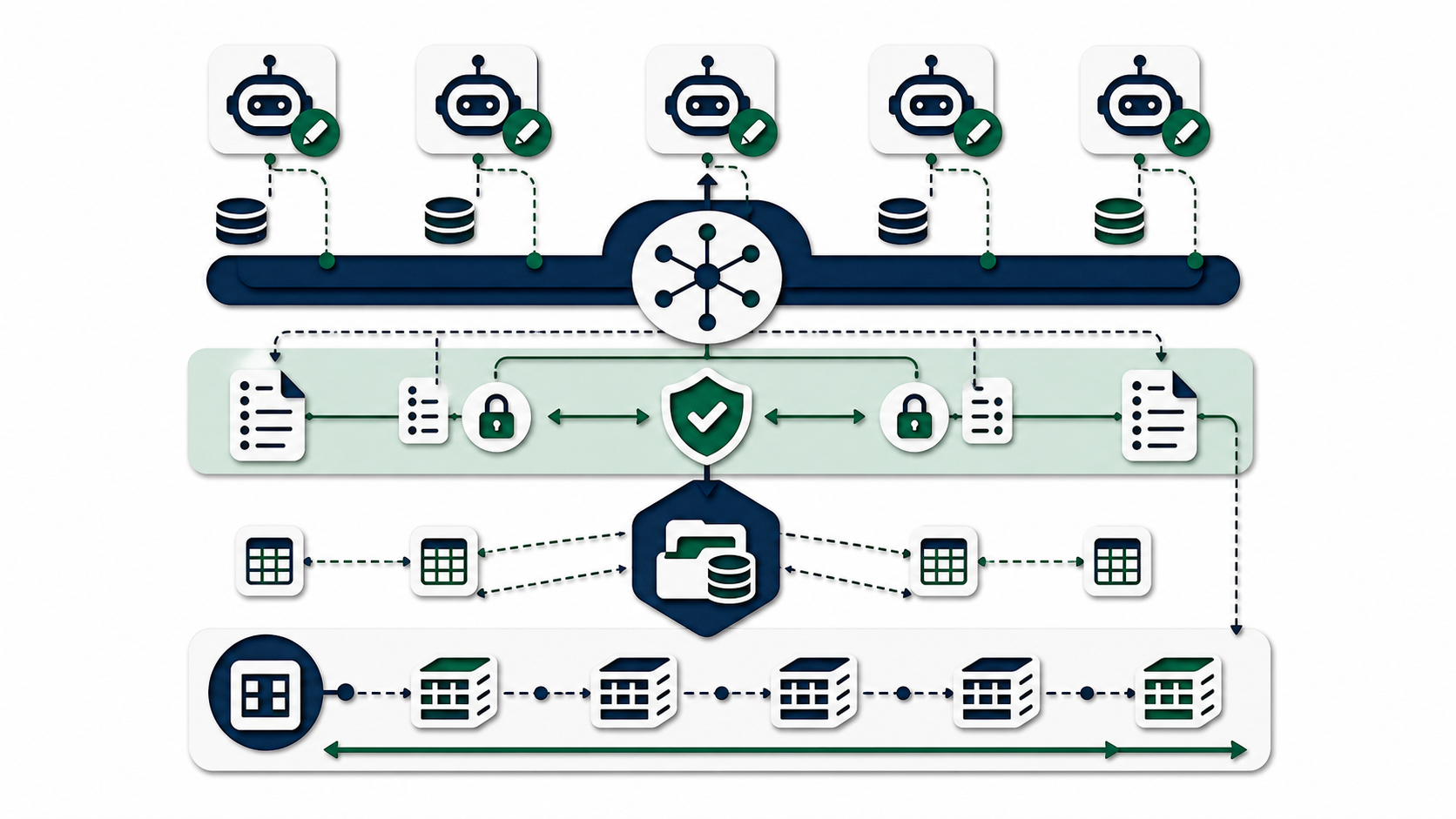
Agents can make the pattern less predictable. An agent may detect a data-quality issue and request a repair. Another agent may monitor cost and request compaction. A third may write evaluation results. A fourth may update a derived feature table. Many of these actions may be individually small, but together they can create high-frequency table operations.
The risk is not that agents are bad writers. The risk is that automated writers can pile up without the social friction that slows human operations. A person may wait before rerunning a failed job. An agent may retry immediately. A person may ask whether another maintenance job is running. An agent may need that rule encoded.
The table layer needs to detect conflicts. The orchestration layer needs to manage behavior.
Iceberg's Snapshot Foundation
Iceberg tables are organized around snapshots. A snapshot represents the table state at a point in time. Writers create new metadata and attempt to commit a new table state. If the table changed in a conflicting way since the writer planned its operation, the commit may need to fail or retry.
This optimistic model is valuable because it avoids heavy locks for many workloads. Writers can work independently and coordinate at commit time. For append-heavy workloads, this can scale well.
But optimistic concurrency is not a promise that all writes will succeed. It is a mechanism for preserving consistency while allowing concurrent work. When conflicts occur, the system has to decide what to do.
That is where agentic orchestration becomes important.
Conflict Is Not One Thing
Not all conflicts are equal.
Two agents appending independent files to different partitions may be easy to reconcile.
Two agents attempting to compact the same files may waste work or conflict.
An agent running a merge while another changes schema may require careful ordering.
A repair job and a privacy delete may need strong precedence rules.
A streaming writer and a table maintenance job may both be legitimate, but maintenance should not starve ingestion.
Conflict handling should classify the type of operation, the affected table area, the business priority, and the safety implications.
That classification cannot live only inside the table format. It belongs in the orchestration policy.
Retry Discipline
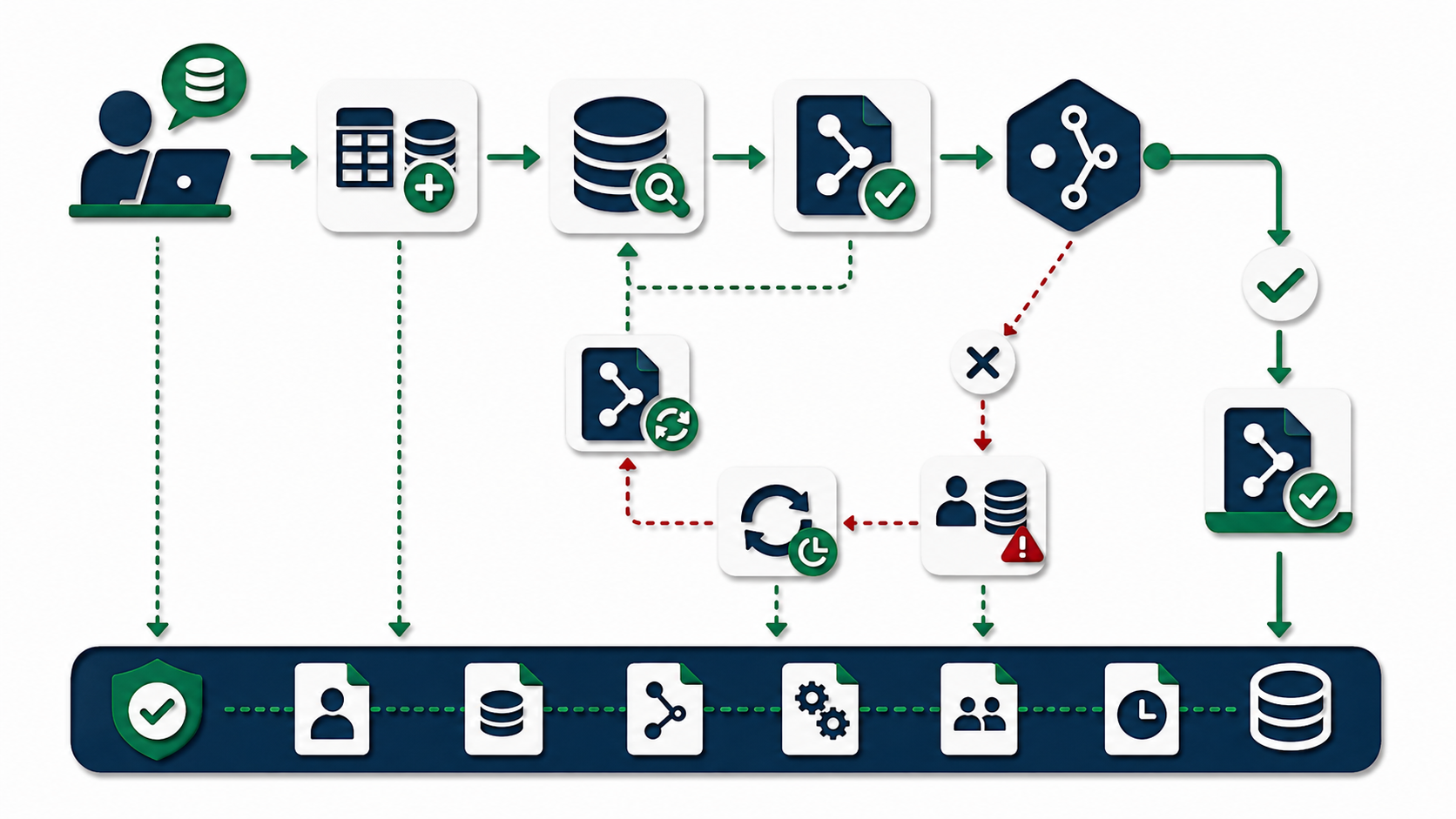
Retries are dangerous when they are naive. An agent that retries immediately on every conflict can amplify contention. Many agents doing that can create a retry storm.
Retry policy should include backoff, jitter, retry limits, conflict classification, and escalation. Some operations can retry safely. Some should be rescheduled. Some should be cancelled. Some should require human review.
Idempotency is also required. If an agent retries a write, it should not create duplicate records, duplicate files, or repeated external actions. Operation IDs, deterministic output paths, merge keys, and intent logs can help.
Retry discipline is one of the practical differences between a demo and production.
Isolation Contracts
An isolation contract defines what an agent is allowed to change and under what conditions.
For example, an evaluation agent may append rows to an evaluation-results table but not alter schema. A compaction agent may rewrite files but not change business data. A data-quality repair agent may write to a quarantine table but not delete production rows. A privacy workflow may have priority over optimization.
These contracts should be explicit. They should be enforced through roles, tools, orchestration policy, and audit. Agents should not receive broad write access just because the table format can handle transactions.
The lakehouse should treat agents as specialized workloads, not all-purpose administrators.
Maintenance Jobs and Agent Writes
Table maintenance becomes more complicated when agents are active. Compaction, clustering, snapshot expiration, statistics refresh, and metadata cleanup can all interact with writes.
A good platform schedules maintenance based on table health and workload patterns. It should avoid competing with ingestion, respect privacy workflows, and coordinate with high-priority writes.
Agents may recommend maintenance, but the maintenance service should apply policy. An agent should not independently decide to compact a heavily used table during peak business hours unless the platform has approved that behavior.
This is where autonomous performance needs governance. Automation is useful when it reduces toil. It is risky when it creates invisible contention.
Observability for Concurrency
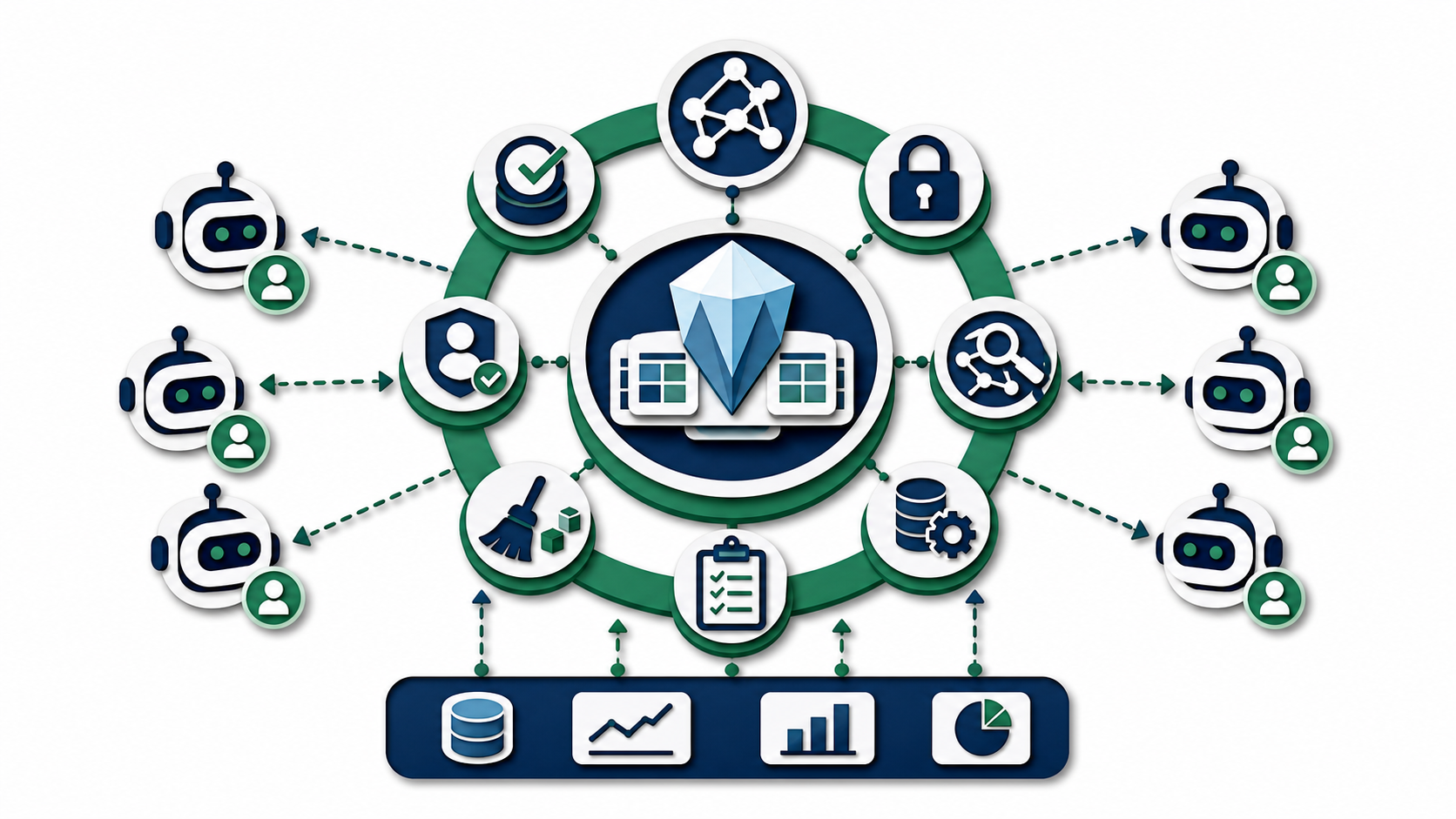
Concurrency problems are hard to fix without visibility. The platform should track commit attempts, commit failures, retry counts, conflict types, table operations, affected partitions, maintenance jobs, and agent identities.
It should also connect these events to business impact. A failed compaction may not matter immediately. A blocked privacy delete does. A delayed ingestion commit may affect dashboards. A schema conflict may break downstream jobs.
Agents should be part of the trace. If an agent requested a write, the system should record the reason, input data, tool call, policy decision, and outcome.
This observability is also how teams improve orchestration. If the same conflict happens repeatedly, the policy should change.
The Role of the Query Layer
Concurrency is not only about writers. Readers need consistent behavior too. A query should read a valid snapshot. A user or agent should know whether a result is based on data before or after a repair. A semantic metric should point to trusted table states.
The query layer helps make table state usable. It can expose snapshot-aware reads, accelerate stable workloads, and provide consistent access across users and agents.
Dremio's lakehouse approach fits here because agentic workflows need both safe writes and reliable reads. Open table transactions are the foundation. Fast governed query access is how people and agents use the result.
Practical Patterns
Use operation IDs for every agent-initiated write.
Use intent logs for workflows that may retry.
Limit agent write scope by table, namespace, operation type, and role.
Separate recommendation from execution for high-risk changes.
Use backoff and retry limits.
Schedule maintenance with awareness of ingestion and business priorities.
Track conflicts by type.
Make privacy and compliance operations higher priority than optimization.
Expose table health to agents through read-only tools.
Review repeated conflicts as platform design issues.
Where Optimistic Concurrency Struggles
Optimistic concurrency works best when conflicts are relatively rare and retries are cheap. It can struggle when many writers target the same table areas at the same time.
Agentic workloads can create that pattern unintentionally. If several agents observe the same table-health issue, they may all request maintenance. If several repair workflows respond to the same data-quality failure, they may target the same partitions. If agents retry aggressively after a conflict, the conflict rate can increase instead of decrease.
The problem is not Iceberg. The problem is workload coordination. Optimistic concurrency protects table consistency, but it does not guarantee efficient progress under heavy contention.
This is why high-frequency agentic writes need admission control. The platform should decide which operations can run now, which should queue, which should merge, and which should be rejected.
Transaction Queues and Write Leases
One practical pattern is a transaction queue for sensitive tables. Agents do not write directly. They submit intents. The orchestration layer orders, batches, or rejects those intents based on policy.
For example, multiple agents may request compaction on the same table. The queue can collapse those requests into one maintenance job. Multiple repair requests for the same partition can be grouped. A low-priority optimization can wait behind ingestion.
Another pattern is a write lease. A workflow obtains a scoped lease for a table, partition, or operation type. The lease does not replace Iceberg's commit validation. It reduces avoidable conflicts by coordinating intent before work begins.
Leases should be narrow and time-limited. A broad long-lived lock can create bottlenecks. The goal is coordination, not serialization of every operation.
Idempotency by Design
Idempotency deserves its own design step. Every agentic write workflow should answer: what happens if this operation runs twice?
For append-only writes, use deterministic operation IDs and de-duplication keys.
For derived tables, write outputs to deterministic locations or use replace-by-operation patterns.
For external actions, separate table writes from API calls and record action state.
For retries, make the agent check whether the operation already succeeded before attempting it again.
For repair workflows, record which source rows or keys were affected.
Idempotency is not only a streaming concern. It is the safety net for every automated writer.
A Production Example
Imagine an agent monitors data-quality checks for a customer usage table. A freshness check fails. The agent investigates lineage and discovers that one upstream partition arrived late. It recommends a backfill.
A naive system lets the agent trigger the backfill immediately. Another agent sees the same failure and triggers another backfill. A maintenance job is also compacting the table. Now the table has competing writes.
A better system routes the request through orchestration. The agent submits an intent with table, partition, reason, and priority. The orchestrator sees that a backfill for the same partition already exists and attaches the new evidence to the existing workflow. It waits for compaction to finish or pauses low-priority compaction. It runs the backfill with an operation ID. It validates row counts. It commits once. It logs the outcome.
That example shows the difference between agentic action and governed agentic operation.
Testing Concurrency Before Production
Teams should test concurrency deliberately. Do not wait for production to reveal conflict behavior.
Run multiple append jobs against the same table.
Run append and compaction together.
Run schema evolution while reads continue.
Run repair jobs against overlapping partitions.
Run agent retries with simulated failures.
Run privacy deletes during maintenance.
Run snapshot expiration after heavy write activity.
Measure commit failures, retry behavior, latency, table health, and downstream query correctness.
The goal is not to eliminate every conflict. The goal is to make conflict behavior predictable.
Read Consistency for Agents
Agents need to know what they are reading. If an agent validates a repair, it should read the snapshot that includes the repair. If it explains a dashboard result, it should know which snapshot the query used. If it compares before and after, it should use explicit table versions.
Snapshot-aware reads are one of Iceberg's strengths. The platform should expose that strength to agents through tools and explanations.
This helps avoid confusion during active maintenance. A user may ask why a number changed. The agent can explain that a new snapshot included late-arriving data or a repair commit.
Concurrency and Semantic Assets
Semantic assets depend on table state. If a metric points to a table while that table is being repaired, the platform needs to decide whether the metric remains certified.
Some repairs may not affect metric validity. Others may require temporary warnings. A high-risk correction may require semantic assets to show a freshness or quality caveat until validation completes.
Agents should read these states. They should not present an answer as fully trusted if the underlying table is in a known repair workflow.
This connects concurrency to semantic governance. Writes are not isolated technical events. They affect business meaning.
Prioritization Rules
Not all operations deserve equal priority.
Privacy and compliance operations should usually outrank optimization.
Ingestion for critical reporting may outrank exploratory derived-table writes.
Maintenance for a heavily used table may outrank maintenance for a cold table.
Agent-generated evaluation writes may be lower priority than production data corrections.
These priorities should be encoded. Otherwise the platform relies on arrival order, which is rarely the same as business importance.
Human Review for High-Risk Writes
Some writes should never be fully automatic. Schema changes, deletes from regulated tables, major repairs, and production feature updates may need human approval.
The agent can still help. It can gather evidence, summarize affected tables, propose the operation, estimate impact, and prepare validation queries. But the approval belongs to a responsible owner.
This keeps agents useful without making them unaccountable.
Operational Metrics for Concurrency
Concurrency health should be measured. A platform team should track commit attempts, commit successes, commit failures, retry counts, average retries per operation, time to commit, queue depth, lease wait time, operation type, and affected table area.
Those metrics should be sliced by table, namespace, writer identity, and workflow. If one agent or table causes most conflicts, the team needs to know. If retries increase after a new workflow launches, that is an early warning. If maintenance jobs regularly block ingestion, the schedule or priority model needs work.
Business-facing metrics matter too. Which dashboards were delayed? Which data products were stale? Which compliance workflows waited? Which users saw warnings? Concurrency is technical, but its impact is business-facing.
Compaction Coordination
Compaction is often where concurrency issues become visible. It rewrites files, touches table metadata, and may overlap with ingestion, deletes, and repairs.
A good compaction policy should know table heat, delete density, file counts, query patterns, and write activity. It should avoid running heavy maintenance against hot partitions unless the benefit is clear. It should pause or back off when higher-priority writes need the table.
Agentic systems can help by identifying tables that need maintenance, but the final scheduling should go through policy. An agent may notice that a table has too many small files. The platform should decide when to compact, how much to compact, and how to avoid conflicts.
This is where autonomous performance becomes valuable. The system can observe table health and act intelligently, but the action should remain governed.
Incident Response for Write Conflicts
When conflicts become incidents, teams need a runbook.
First, identify the table, operation types, writer identities, and time window.
Second, determine whether data correctness is at risk or only job progress.
Third, pause low-priority writers if needed.
Fourth, inspect recent commits and failed attempts.
Fifth, decide whether to retry, reschedule, roll back, or escalate.
Sixth, communicate affected data products and semantic assets.
Seventh, update orchestration policy so the same conflict is less likely to repeat.
Agents can assist this runbook by gathering facts, summarizing impact, and drafting communication. They should not hide the incident behind automatic retries.
Why Academic Proofs Are Not Enough
Formal correctness matters. It is good that table formats and transaction protocols can be reasoned about. But production systems fail in the messy space around the proof: retries, bad credentials, partial workflow state, duplicate external calls, overloaded catalogs, human approvals, and unclear ownership.
That is why I would not evaluate agentic lakehouse concurrency only by the table transaction model. I would evaluate the whole operating system around it.
Can the platform classify conflicts?
Can it prioritize writes?
Can it prevent duplicate action?
Can it explain table state to agents?
Can it pause automation safely?
Can it recover after failure?
Those are production questions.
When Agents Should Only Recommend
Some operations should begin as recommendations, not writes. Schema evolution, production deletes, large table rewrites, and changes to high-value semantic assets usually deserve human review.
That does not make the agent less useful. The agent can collect evidence, identify affected partitions, estimate downstream impact, check policy, propose validation queries, and draft the change request. The human owner then approves, modifies, or rejects the operation.
This pattern gives teams the benefit of agentic investigation without surrendering control over high-impact table state. Over time, low-risk repeated actions can move toward automation. High-risk actions can remain approval-driven.
That balance is what makes agentic lakehouse operations credible.
It keeps automation useful without letting it become reckless.
That is the line.
Hold it.
What This Means for the Lakehouse
Agentic lakehouses need more than autonomous actors. They need a governed open table foundation and a platform that makes that foundation usable.
Iceberg provides the transactional table layer. Fast query, federation, and semantic context together make the lakehouse accessible. Those ideas point toward a lakehouse where agents can assist operations without turning tables into a contested write surface.
The conclusion is not that agents should write everywhere. The conclusion is that when agents do write or request writes, the lakehouse needs explicit contracts.
The Direction of Travel
As agentic systems mature, automated write pressure will increase. Some agents will write evaluation data. Some will request repairs. Some will manage maintenance. Some will produce derived tables. Some will trigger workflows.
The organizations that succeed will not be the ones that let every agent do everything. They will be the ones that combine Iceberg transactions with orchestration, idempotency, policy, observability, and semantic control.
Trustworthy concurrency is a platform discipline. It is also a prerequisite for the Agentic Lakehouse.
For more of my thinking on data lakehouse and AI architecture, explore my books at books.alexmerced.com. To try a modern Agentic Lakehouse experience, visit dremio.com/get-started.